

Gaps between floorboards are one of the most common things we get called out to look at in Melbourne homes. Sometimes it’s a homeowner who has just pulled up the carpet and found beautiful old timber boards with daylight showing between half of them. Other times it’s someone who’s lived with the floor for years and noticed the gaps getting wider every winter.
The short answer: gaps up to 15mm are filled during a full sand and polish, using a dust-matched filler for fine joints and a flexible filler for wider ones. Anything wider than 15mm usually needs the board replaced rather than filled. Small gaps that open and close with the seasons are often better left alone.
The longer answer depends on your floor. Here’s how we work out which is which, and what we actually do about it.
Why Gaps Open Up in Melbourne Homes
As a natural material, timber never really stops moving. It takes on moisture from the air in humid weather and releases it when the air dries out, so boards swell slightly in summer and shrink again through winter. Melbourne’s seasonal swings are enough to make that movement visible, and gas heating running through winter dries a house out even further.
That’s the normal, healthy cause of gaps in a timber floor. The other reason we see gaps is age. Many of the floors we restore across the inner suburbs were first laid in the 1920s or earlier and were never meant to be seen. After a hundred-odd years of seasonal cycling, those boards have permanently shrunk a few millimetres each, and once you multiply that across a room, you get gaps you can easily lose a coin in.
Then there’s the third category, which is gaps caused by something going wrong. Boards that have cupped from moisture underneath, fixings that have worked loose, or joists that have moved. These floors need the cause addressed before anyone reaches for filler.
The First Thing We Check
When we quote, the first thing we look at is the size of the gaps and whether the gaps are still moving.
A gap that opens and closes with the seasons behaves very differently to one that has settled. If we fill a moving gap with something rigid, the boards have nowhere to go when they swell back, and the filler gets crushed and can make the problem worse.
We look at the time of year, the condition and species of the timber, the subfloor, and how the gaps are distributed through the room. Gaps that are even across the whole floor usually mean normal shrinkage. Gaps concentrated in one section, or boards that are cupped or lifting at the edges, usually mean moisture is getting in somewhere, and that’s a conversation before it’s a filling job.
When Should You Not Fill Gaps in Floorboards?
We often get asked to fill gaps on a floor that doesn’t need it, and we’d rather say so than take the money and have you unhappy in twelve months.
The expansion gap around the perimeter of the room is the clearest example. That gap is there on purpose. It’s what lets the whole floor expand without buckling, and it should never be filled. Skirting boards and scotia are there to cover it.
We’ll also usually leave small seasonal gaps alone on a solid floor that’s still moving freely, unless we’re using something flexible enough to move with it. And if a floor is cupping or the boards are loose underfoot, that’s a repair job first.
How We Fill Gaps During a Sand and Polish
For most floors, gap filling happens in the middle of a full sand and polish rather than as a job on its own. Filling a bare, freshly sanded floor gives a far better result than working around an existing finish, and the coating then locks everything in.
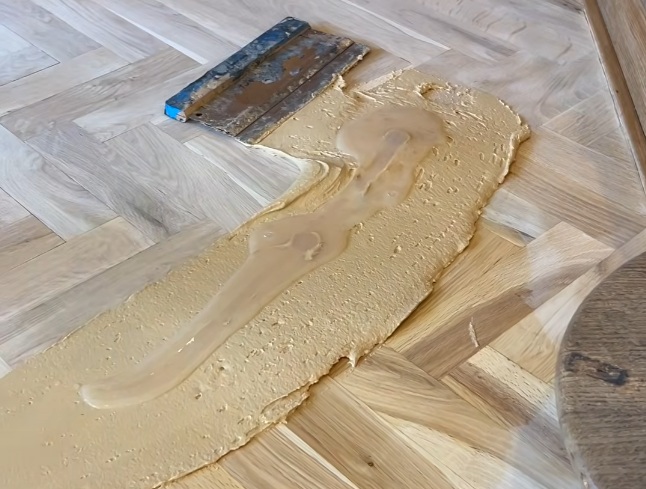
Once we’ve done our rough sanding passes, we mix Berger-Seidle Pafuki with the fine sanding dust taken from your own floor. That dust is what gives the fill its colour, so the result matches your timber rather than sitting there looking like putty. We trowel the mix across the entire floor, press it into every joint, then leave it to dry before we sand it back flush and buff off the excess.
Pafuki handles the small stuff (usually found in parquetry floors and only 1-2mm wide), and for wider gaps we switch to Berger-Seidle Pak Stop, which stays permanently elastic once cured. That flexibility matters on an older floor that still has movement, because a rigid product in a wide gap will eventually crack out.
On floors that aren’t being sanded, or for a one-off gap in a prominent spot, FlexFill can be applied straight into the gap from a cartridge and levelled off. It’s the option we point people to when the rest of the floor is in good shape.
See the Process in Action
Here’s a double herringbone Tasmanian Oak floor we filled using Pafuki mixed with the dust from the sanding passes.
GAPPY FLOORS?? | How to fill small gaps | Hardwood Parquet Floor
When the Gaps Are Too Wide for Filler
Past a certain point, no filler is the right answer. This is where many of the old Melbourne floors we work on end up, and where we recommend a proper timber repair.
Where boards are split, damaged or missing altogether, we cut them out and replace them. That covers water damage and termite damage as well, both of which we see regularly in older homes across Melbourne.
The hardest part is finding the right match. Dropping a brand new board into a hundred-year-old floor will stand out badly, because the surrounding timber has changed colour over decades of light and wear. We source new or reclaimed boards to suit what’s already there, so the repair blends into the floor once everything is sanded and coated together.
Replacing a board also deals with the root cause rather than the symptom. A gap that exists because the board beside it has split, or because someone cut around old plumbing, won’t be solved by anything you pour into it.
Which Fix Suits Which Gap
| What we’re dealing with | How we handle it | Why |
|---|---|---|
| Gaps up to 2mm | Berger-Seidle Pafuki mixed with sanding dust from your own floor | Troweled across the whole floor during sanding so the colour matches your timber exactly |
| Gaps from 3mm to 15mm | Berger-Seidle Pak Stop | Stays permanently elastic, so it holds up on older floors that still move with the seasons |
| A one-off gap on a floor that’s otherwise fine | Berger-Seidle FlexFill | Applied straight from a cartridge without sanding the floor back |
| Gaps wider than 15mm | Board replacement with matched timber | No filler is reliable at that width |
| Gaps that open and close with the seasons | Usually left alone, or filled with a flexible product | Rigid filler gets crushed when the boards swell back |
How Much Does Gap Filling Cost?
This really depends on the method used. We will always provide a detailed quotation for you to consider before moving forward.
Costs change when boards need replacing, and that depends on how many boards are involved and how hard the timber is to match.
Our guide to floor sanding and polishing costs covers what a typical restoration runs to in Melbourne, but getting a free estimate is the best way to know for sure how much your floor restoration could cost.
Book Your Timber Floor Assessment
Every floor is different, and gaps are one of those things that are very hard to price or diagnose from a photo. The best thing to do is have us come and take a look.
Quicksand Flooring has been restoring timber floors across Melbourne and the Mornington Peninsula for more than 25 years, including breathing new life into historic flooring that’ll last for decades.
Contact us online today for a free estimate or call us on 0451 326 307, and we’ll tell you honestly what your floor needs.
Frequently Asked Questions
Can you fill gaps without sanding the whole floor?
Yes, for a one-off gap. A cartridge filler like FlexFill can be applied to a finished floor and levelled off without sanding anything back. Filling every gap across a whole room is a different job, and that’s done properly as part of a full sand and polish, because the filler needs to be troweled across bare timber and sanded flush before coating.
Why do gaps in my floorboards appear in winter?
Timber gives up moisture when the air around it dries out, so boards shrink slightly through the colder months and the joints between them open up. Heating accelerates it by drying the house out further. On most solid floors, those gaps close again over summer, which is why we check whether a gap is still moving before filling it.
How wide is too wide to fill?
Around 15mm. Past that width, no filler holds up reliably over time, and replacing the board is the better result.
Will the filler crack and fall out again?
Not if the right product goes into the right gap. Cracking almost always comes down to a rigid filler being used in a gap that’s still moving with the seasons, or an underlying moisture problem that was never addressed. That’s why we assess the floor before we quote rather than filling everything on sight.
Do you replace damaged floorboards as well?
Yes. We replace boards that are split, damaged or missing, including water and termite damage, and we source new or reclaimed timber to match your existing floor so the repair blends in once everything is sanded and coated together.

With over 25 years of experience, Clinton Tracy is a Melbourne timber flooring expert dedicated to delivering exceptional results. He and his team constantly test new products and finishes to ensure the highest quality.
Clint’s commitment to excellence includes traveling to Europe to stay updated with the latest industry trends and best practices, ensuring every project meets the highest standards.